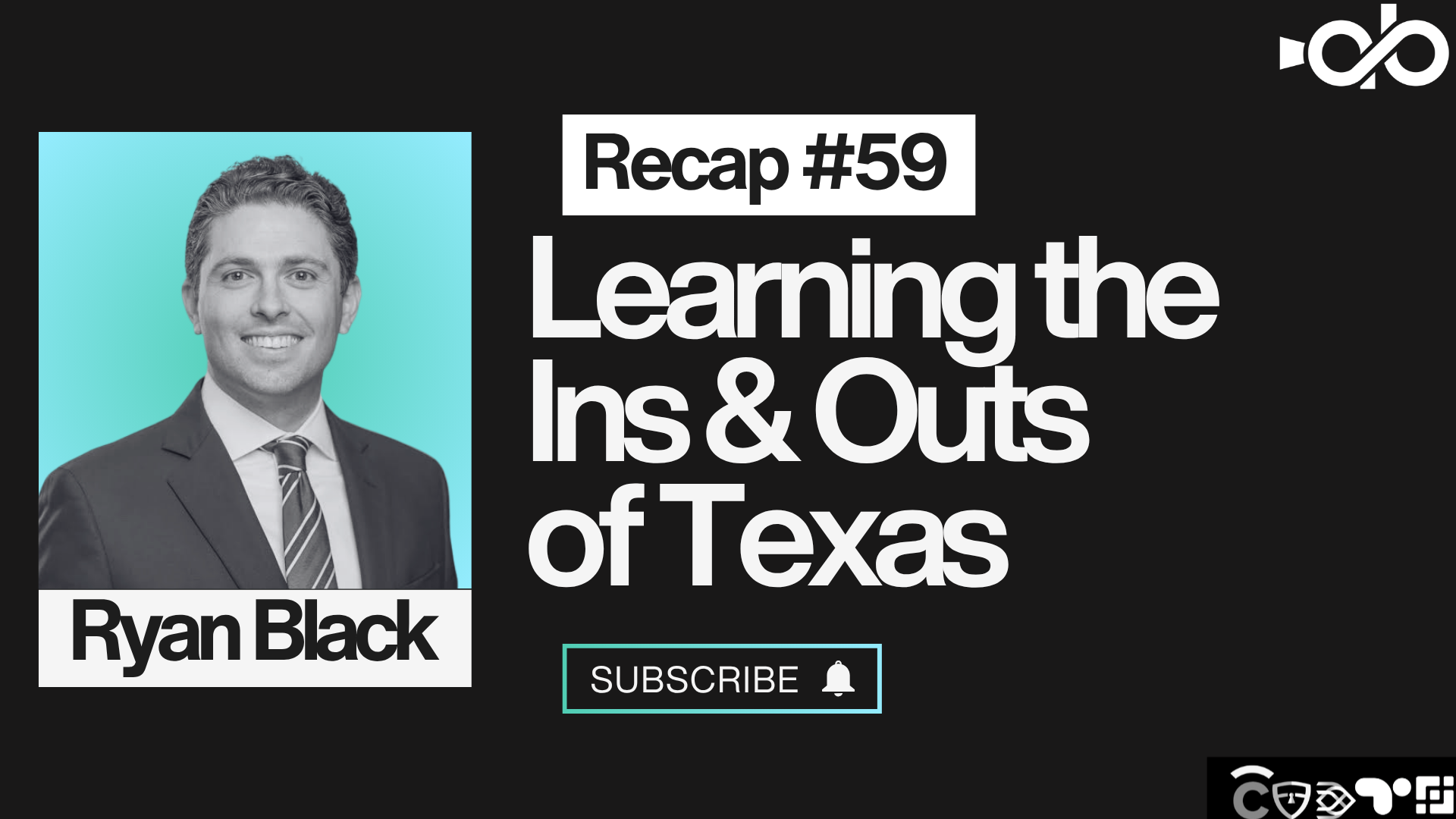
Learning The Ins and Outs of Texas with Ryan Black
Welcome to another edition of The MikedUp Show! Over the past several months, we’ve welcomed many insightful guests who gave us tons of great advice. But recently we thought, “What about the fantastic leaders and visionaries who spoke with us before we started making newsletters??” Well, folks, we thought it was time to give them their moment in the sun.
Some of our chats are about rates, volume, and market shifts. Others reveal something more foundational: the legal realities that quietly shape how mortgage gets done in the first place. On this episode back in July of 2024, we sat down with Ryan Black of Black, Mann, & Graham LLP to talk about one of the most unique corners of mortgage lending in the country: Texas..
Truework is the only all-in-one, automated VOIE platform that fully replaces costly in-house verification waterfalls by orchestrating all major verification methods within a single platform. With an industry-leading 75% completion rate, we have helped mortgage providers achieve up to 50% cost savings on their verification process, resulting in multi-million dollar savings. Looking to save on verification costs while improving borrower experience and pull-through? Let’s talk.
TEXAS IS DIFFERENT, TO SAY THE LEAST
One of the clearest takeaways from our conversation with Ryan is that Texas is not just another state on a lender’s expansion map. It has a legal framework that changes how mortgage companies must think, operate, and grow. As Ryan explained, if you are originating loans in Texas, a law firm must prepare the closing documents, because that work is treated as the practice of law. That alone creates a very different operating environment from what lenders see in most other states.
That distinction is not just procedural. It affects how lenders enter the market, how they staff for it, how they train for it, and how they think about execution risk. Ryan described Texas as the one state where a mortgage company truly needs a law firm like his to prepare documents for originations, and he noted that this structure puts firms like Black, Mann, & Graham in a unique position to comment on federal regulations, consumer protection laws, and state rulemaking. For many outside the state, Texas can seem intimidating. Ryan acknowledged that feeling, noting that firms often say they are hesitant to enter Texas because the rules look too complicated. But his answer isn’t to recommend they stay away it’s quite the opposite. “It’s easy once you get a couple under your belt,” he said.
Homeowners insurance rates have been rising fast, and it's now a double digit driver of loan fallout. Most lenders aren't tracking it because it gets mislabeled as "conditions not met" or "borrower withdrew" and is never traced back to the real cause.
Covered's CEO Ross Diedrich is at nSight 2026 in Charlotte this Thursday May 14th at 2pm to break down what's driving it and what embedded insurance infrastructure looks like inside the tools you and your team already use.
Not attending nSight? Visit itscovered.com to learn more.
8:03 - 8:40 -- "Texas has in our Constitution protections for the 'homestead,' which is essentially the primary residence of Texans. That's been baked into our DNA since Texas broke away from Mexico. It was a policy of the country of Texas before they joined the United States, and it was a way to encourage immigration from other states like Tennessee, Kentucky, etc. It was an interesting tactic because they were essentially saying, 'Hey, forget about all your creditors that are chasing you out there - come to Texas.'"
PROTECTING YOUR CONSUMERS ALSO PROTECTS THE BOTTOM LINE
Another powerful theme in the episode was Ryan’s perspective on consumer protection. In many corners of the industry, protections are talked about as constraints or friction points. Ryan frames them differently. In Texas, some of the strongest equity-loan consumer protections in the country are embedded directly into the state constitution, and changes to those rules require broad collaboration among lenders, builders, real estate interests, and consumer advocates.
That framework matters because it forces the industry to think not just about access to credit, but about the integrity of the borrower experience. Ryan explained that the goal is to tailor laws in ways that give borrowers access to financing they otherwise would not have, while still preserving the laws that protect them. He also offered reasoning for understanding the “why” behind these laws. Originators in Texas require a spouse to sign security documents even if that spouse is not on the note. Without context, that can feel like just another frustrating rule. With context, it becomes part of a broader story about how Texas has historically treated the family home.
27:13 - 27:47 -- "Here in Houston, I was doing sales before I got into doing this legal stuff a few years ago. I would frequently attend the local luncheons where big conversations would happen. And some of those groups that had been around for decades aren't around anymore. So you think, 'Well, where are those conversations happening that used to be happening at these luncheons?' It's on the Facebooks of the world and podcasts like this."
WHAT YOU REALLY NEED TO GO FROM BROKER TO BANKER
The conversation also moved to a highly relevant transition point within the industry: the move from broker to banker. Ryan’s firm has lived close to that evolution for years, including through relationships with warehouse line providers and fulfillment structures built to help brokers expand their business model. What Ryan made clear is that this shift is neither simple nor always appropriate.
There are real advantages to becoming a banker, including broader compensation and more control over the process. But there is also more responsibility, more risk, and more infrastructure required to do it well. That is an important point. Many lenders are tempted by scale before they have fully defined what scaling actually is. Ryan’s advice was simple. Ask questions. Understand the model. Talk to the right people before making the move. Sometimes the best advice isn’t “go bigger,“ it’s ”understand the pitfalls first.”
BUILDING RELATIONSHIPS TO ENHANCE YOUR LEADERSHIP
The final layer of the episode was advocacy and relationships, and this is where Ryan’s story became especially compelling. He is second generation in the business, grew up around mortgage, tried to avoid it, spent years in politics in Washington, and then eventually found his way back to the industry through law and policy. That path gave him a perspective that is wider than just doc prep. He understands how change happens, how trade groups influence policy, and why being present at advocacy conferences matters.
That long-game mindset showed up repeatedly in the way he talked about relationships. He was candid that national conferences are rarely about instantly flipping someone into a client at the bar. They are about repeated exposure, staying visible, and being present when the opportunity eventually appears. That is a huge lesson for the industry. Good advocacy and strong relationships aren’t abstract. They are practical. Not only do they give you a reputation of credibility and consistency, they give your customers the comfort of a familiar voice at the table.
Full episode
To hear more lively discussions and special guest insights in the realm of mortgages and real estate, check out TheMikedUp Show with Mike Kelleher and Michael Zau, every Thursday at 2pmET!
THE ABOVE IS A SUMMARY OF INSIGHTS & ANECDOTES TAKEN FROM AN HOUR-LONG PODCAST EPISODE OF THEMIKEDUP SHOW. MIKE & MIKE RESERVE THE RIGHT TO PARAPHRASE WHEREVER NECESSARY.

Host/CEO, Adopt The Brand
I pioneered white label mobile apps in the mortgage industry that processed over $500 billion in loan volume and served 32,000+ loan officers.
For the past decade, I've navigated the complex intersection of mortgage and technology:
Built relationships with 200+ IMB CEOs, 20 banks, and 15 credit unions
Sold over $10M in SaaS contracts to an industry resistant to change
Sold over 20 million in annual contracts of services.
Managed product roadmaps and legal frameworks for enterprise integration of other contratsions
Attended 155+ industry conferences, building an unmatched network
I don't just open doors—I build bridges between innovative tech and mortgage leaders who need solutions.
When we work together, you get:
A translator who converts your tech-speak into mortgage value
Implementation strategies that actually work in the real world
Direct access to decision-makers you'd otherwise spend 6+ months trying to reach
My weekly show connects industry leaders and showcases emerging solutions, while my consulting helps companies avoid the $250,000+ mistake of approaching the mortgage market incorrectly.
The mortgage industry doesn't need another shiny app. It needs systems that truly integrate with how lending works.
Stop Creating Problems Just To Make Solutions ft. Brandon Durham